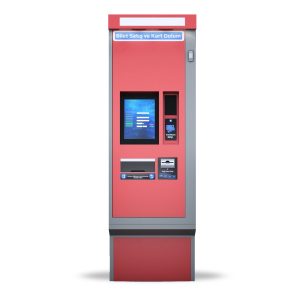
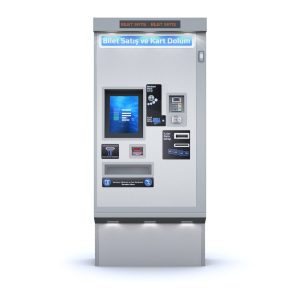
Ticket vending and card top-up kiosk systems let users buy tickets, top up transit cards and complete payments without the need for service staff. Developed for public transportation hubs and busy public spaces, these devices create independent transaction points accessible at all hours of the day.
Noya Tech ticket and card top-up kiosk solutions can be configured according to the project’s transaction scope, payment methods, card infrastructure and operating environment. Touchscreens, card readers, card dispensers, banknote and coin acceptors, change dispensers, printers and communication hardware can be combined in a single system.
Crowding at ticket offices or card service centers can lengthen user waiting times. A card top-up machine lets users perform frequently repeated transactions themselves, providing an alternative to staffed service points.
Users can select the transaction they want on the touchscreen, tap their card and complete the transaction with one of the supported payment methods. In projects involving ticket sales, ticket selection, pricing, payment and ticket printing can also be handled by the kiosk.
Depending on requirements, ticket vending and card top-up kiosk systems can support the following transactions:
The transactions offered on the kiosk should be determined according to the existing software infrastructure of the transportation or ticketing system.
Card top-up machines can be placed at various locations where users need to easily add credit to transit or service cards.
Kiosks used at metro and train stations can support transactions such as card top-ups, ticket sales, balance inquiries and new card issuing. By creating multiple transaction points during heavy passenger traffic, they help reduce the load on ticket offices.
At bus stops, transfer hubs and intercity terminals, they let users complete card transactions before their journey. For devices installed outdoors, screen visibility, enclosure durability and physical security should also be evaluated.
A self-service point can be created for public transportation, transfer and ticketing transactions at airports. A multilingual user interface can help passengers from different countries complete their transactions more easily.
In areas served by ferries and other maritime transport, ticket sales, transit card top-ups and balance inquiries can be performed at the kiosk.
Card top-up machines can be used in service buildings and public areas for selling, topping up or checking municipal transit and city cards.
Project-specific systems can be built for topping up transportation, meal or service cards used on university campuses, large business centers and gated sites.
The hardware used in a ticket vending and card top-up system is determined by the transactions the device will perform. A system that accepts only card payments and a device that accepts cash and gives change do not have the same hardware structure.
The main components that can be considered within the project are:
Not every component is needed in every project. Hardware should be selected after the transactions users will perform and the payment scenarios have been clarified.
The payment methods supported for ticket and card top-up transactions directly affect device design and project cost.
In projects that accept only debit or credit card payments, a more compact device design can be chosen. If cash will be accepted, banknote and coin acceptors, a secure cash box and, if necessary, a change dispenser must be added to the system.
When defining the payment scenario, the following should be evaluated:
The right payment infrastructure makes it easy for users to complete transactions while also simplifying device management for field teams.
Card top-up machines used at bus stops, metro entrances and open-air transit points should be designed to operate in different weather and lighting conditions.
When choosing a device for outdoor use, a durable metal enclosure alone is not enough. The screen must be readable in sunlight, the temperature inside the device must be controlled, the necessary precautions against water and dust ingress must be taken, and electronic components must be kept within suitable operating conditions.
The following features stand out in outdoor projects:
The climate, sun exposure, passenger density and energy infrastructure of the installation site should be examined at the start of the project.
Offering ticket sales and card top-ups via kiosks creates a more accessible transaction network for users and service providers.
Depending on the project, kiosk systems can offer the following advantages:
The benefits depend on the scope of the kiosk software, system integration and placing the devices at the right locations.
The Noya Tech ticket vending and card top-up category includes the E-Life TVM-2000 and E-Life TVM-500 models. Both models can be evaluated for different transaction capacities and field needs in transportation and smart city projects.
The E-Life TVM-500 is an outdoor kiosk model that combines ticket sales and card top-ups in a compact device. In addition to card reader and card dispenser options, it can be configured for banknote and coin acceptance and change-giving needs.
Thanks to its compact cabinet, it can be considered for bus stops, metro entrances, train stations and similar transit points.
The E-Life TVM-2000 is a ticket vending kiosk model developed for projects with more extensive cash management, card transaction and security requirements. It can be configured with various banknote and coin acceptors, recycling mechanisms, card readers and card dispensers.
With its rugged cabinet and remote management infrastructure, it can be adapted to heavily used public transportation and smart city projects.
Every transportation project has a different card infrastructure, payment method and transaction volume. A standard card top-up machine may therefore not be sufficient for every project.
Before configuring the kiosk, the following information should be clarified:
Based on these requirements, the device model, peripherals and cabinet design can be determined.
Card top-up machine prices vary according to many features, from the display to the payment units and from the enclosure design to software integration. A system with cash payment and change-giving does not cost the same as a device that accepts only contactless payments.
The main factors affecting pricing are:
When evaluating the price of a card top-up machine, consider not only the purchase price but also cash collection operations, maintenance needs, energy use, access to spare parts and total cost of ownership.
You can share your project details via our contact page for the details that affect pricing.
In a ticket vending and card top-up project, compatibility with the software, payment infrastructure and field operations is as important as the device’s physical features.
Noya Tech supports you in selecting the kiosk model and hardware components according to project requirements. Within the project, the display, payment units, card reader, card dispenser, change mechanism, communication infrastructure, enclosure design and system integrations can be evaluated together.
This way, instead of simply buying a standard device, you can build a complete kiosk solution configured for the needs of your transportation or service infrastructure.
Share the types of tickets and cards to be sold, the payment methods to be supported, where the device will be used and the estimated transaction volume with us. Let the Noya Tech team get in touch with you to determine the right ticket vending and card top-up kiosk model and hardware configuration for your project.
A card top-up machine is a self-service device that lets users add credit to transit or service cards and check their card balance. Depending on the project, it can also support new card sales, ticketing and payment transactions.
Ticket kiosk systems can be used for processes such as ticket sales, card top-ups, balance inquiries, new card issuing, accepting payments and printing transaction records. The transactions offered vary according to the project and software infrastructure.
Card top-up machines fitted with suitable banknote and coin acceptors can accept cash. Depending on the project, a change dispenser can also be included in the system.
When the payment infrastructure and terminal integration allow, debit card, credit card and contactless payment options can be supported.
Systems with a card dispenser unit can sell or issue new cards. The card type and dispenser capacity should be determined within the project.
With suitable hardware and software integration, ticket sales, card top-ups, balance inquiries and payment transactions can all be performed on the same kiosk.
Models with a display, cabinet, temperature management and protection features suited to outdoor conditions can be used in open areas. The climate and environmental conditions of the installation site should be considered in device selection.
With suitable connectivity and software infrastructure, device status, transaction records and technical alerts can be monitored from a central system. The scope of remote updates and intervention depends on the software used.
Prices are determined by the display, computer, card reader, card dispenser, cash acceptance, change dispensing, payment terminal, cabinet design, software integration and number of devices.
Depending on the model and project scope, the device enclosure, colors, logo, screen interface, payment units and card hardware can be configured as needed.
Your Cookie Preferences
We use strictly necessary cookies to keep our site secure and working properly. Cookies used to measure visit statistics (analytics) and to evaluate the effectiveness of our advertising (marketing) are used only with your explicit consent. You can change your preference at any time via the “Cookie Settings” link at the bottom of the page. Details: Cookie Policy · KVKK Privacy Notice
Cookie Settings
You can choose below which cookie categories you allow. Strictly necessary cookies are required for the site to work and cannot be turned off. Analytics and marketing cookies are used only with your explicit consent under KVKK (Turkish Personal Data Protection Law No. 6698); you can withdraw your consent at any time. Cookie Policy
Strictly Necessary Cookies
Used for displaying pages, security, form submissions, the quote and comparison lists, and remembering your cookie preference. These cookies are not used for personal preference or advertising purposes.
Analytics Cookies
Lets us statistically measure information such as the number of visitors, pages viewed, traffic sources and site performance (e.g., Google Analytics). In this context, data may be transferred to the service provider’s servers abroad.
Marketing Cookies
Used to measure the effectiveness of advertising and remarketing campaigns and to show you content relevant to your interests (e.g., Google Ads, Meta, LinkedIn). In this context, data may be transferred abroad.
Select at least 2 products
to compare